Complete physical receiver
A 9 V breadboard radio with ferrite tuning, discrete RF and audio stages, volume control, and an 8 Ω speaker.
Radio Project
Physical build, LTspice simulation, and interactive schematic explorer for a discrete transistor AM receiver.
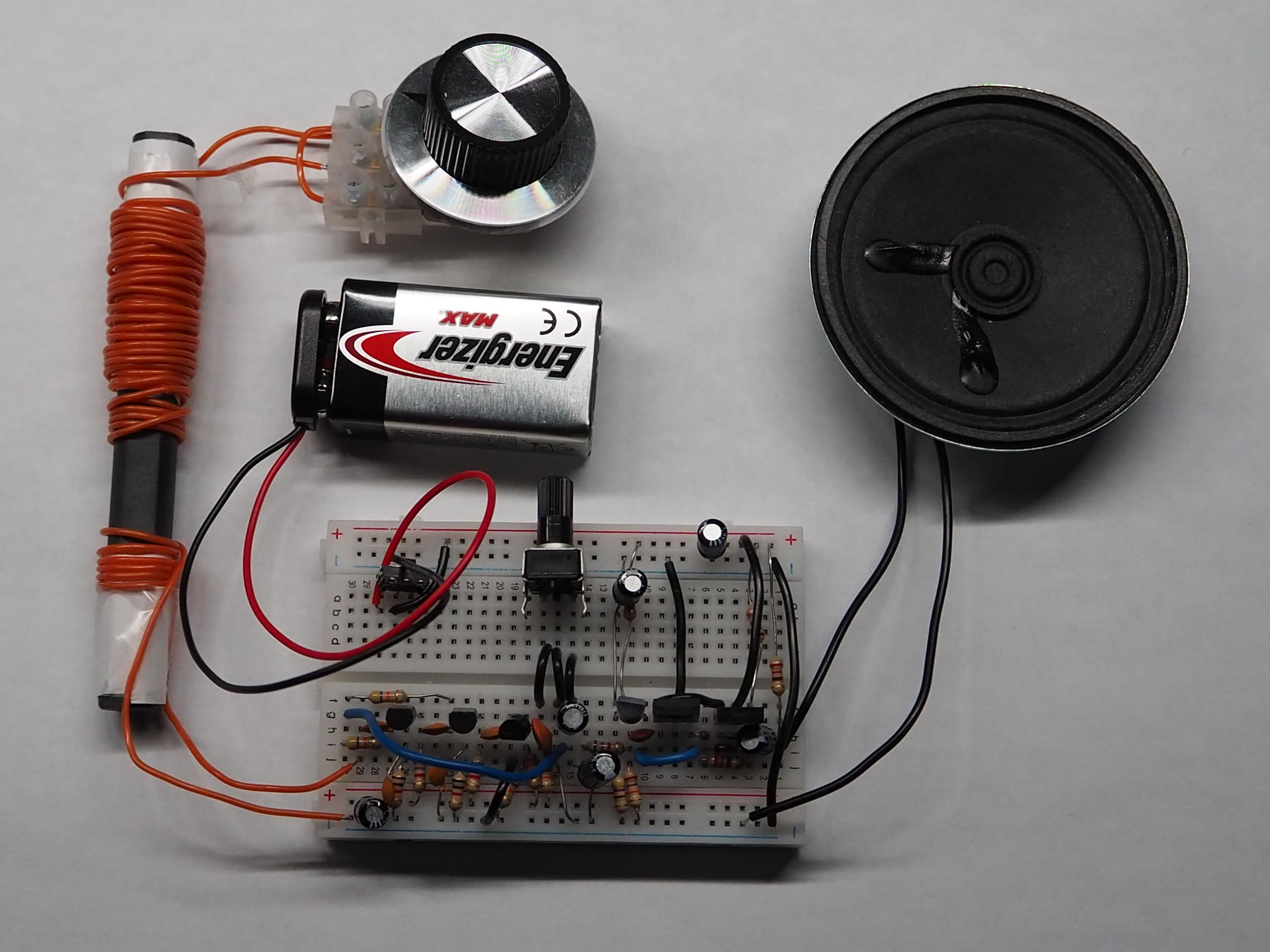
This project is a 9 V battery-powered AM radio receiver built around discrete transistor stages rather than an integrated radio IC. The page documents the physical antenna and tuning build, the LTspice model, and the signal path from RF pickup through audio output.
The completed receiver combines a tuned LC front end, two RF gain stages, transistor detection and volume control, an audio driver, and a complementary BD139/BD140 output stage. This case study presents the design as a complete engineering record: architecture, construction, simulation, measured operating points, troubleshooting method, and downloadable project files.
The physical front end uses a hand-wound coil on a 9.5 mm diameter, 100 mm long ferrite rod and an approximately 200 pF mechanical variable capacitor for tuning. Moving the capacitor changes the resonant point of the LC tank and determines which part of the AM band is emphasized before amplification.
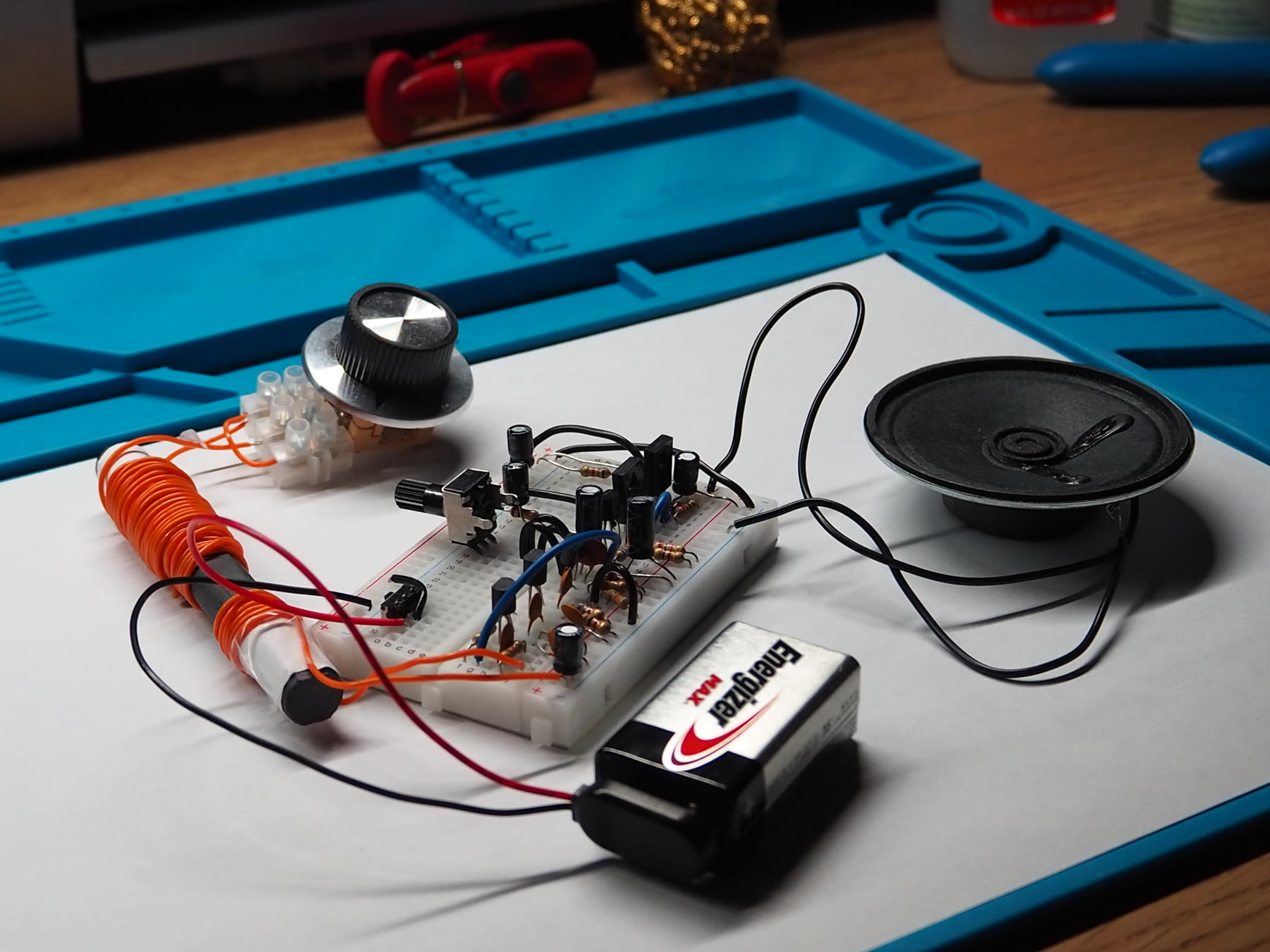
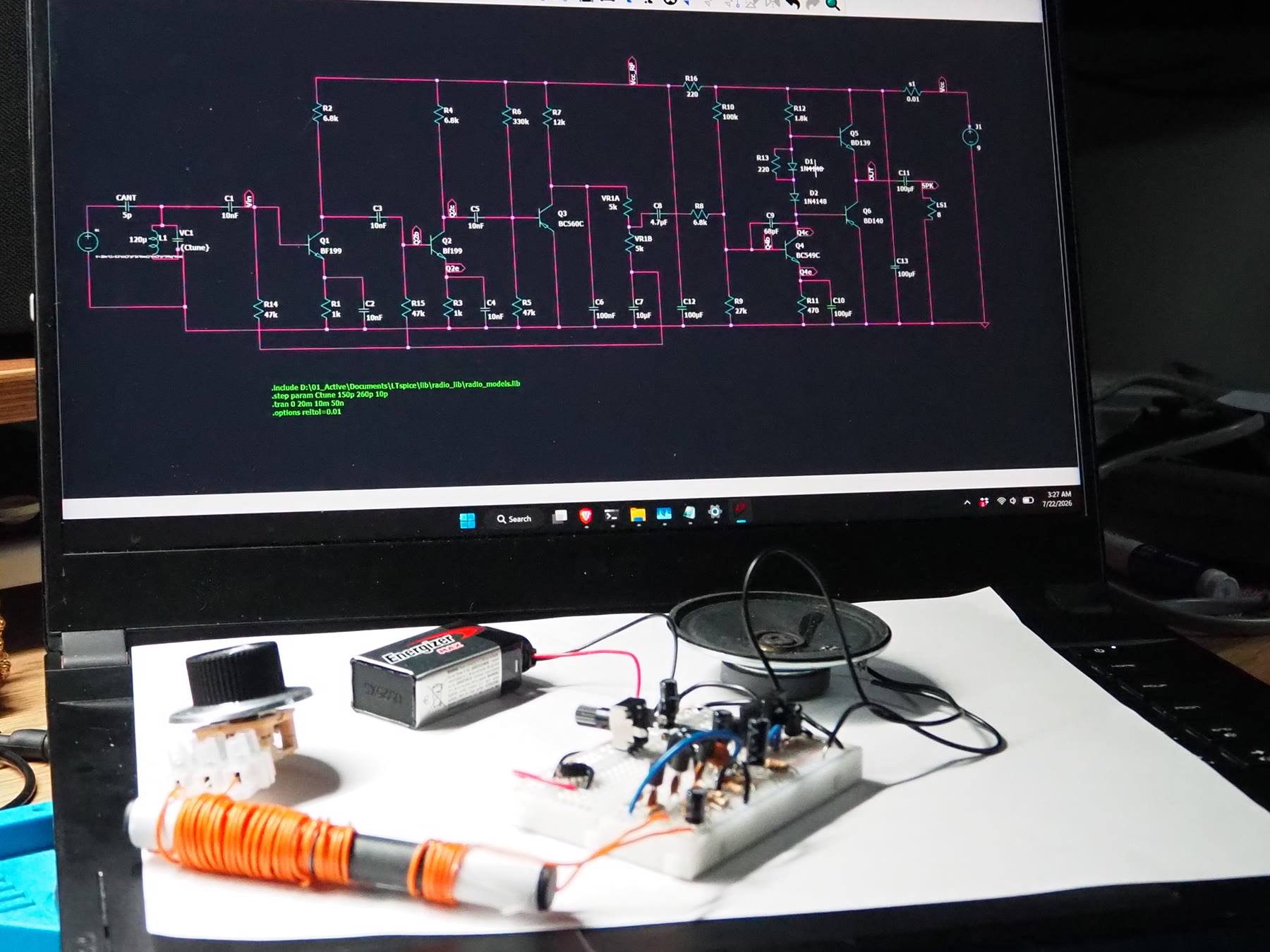
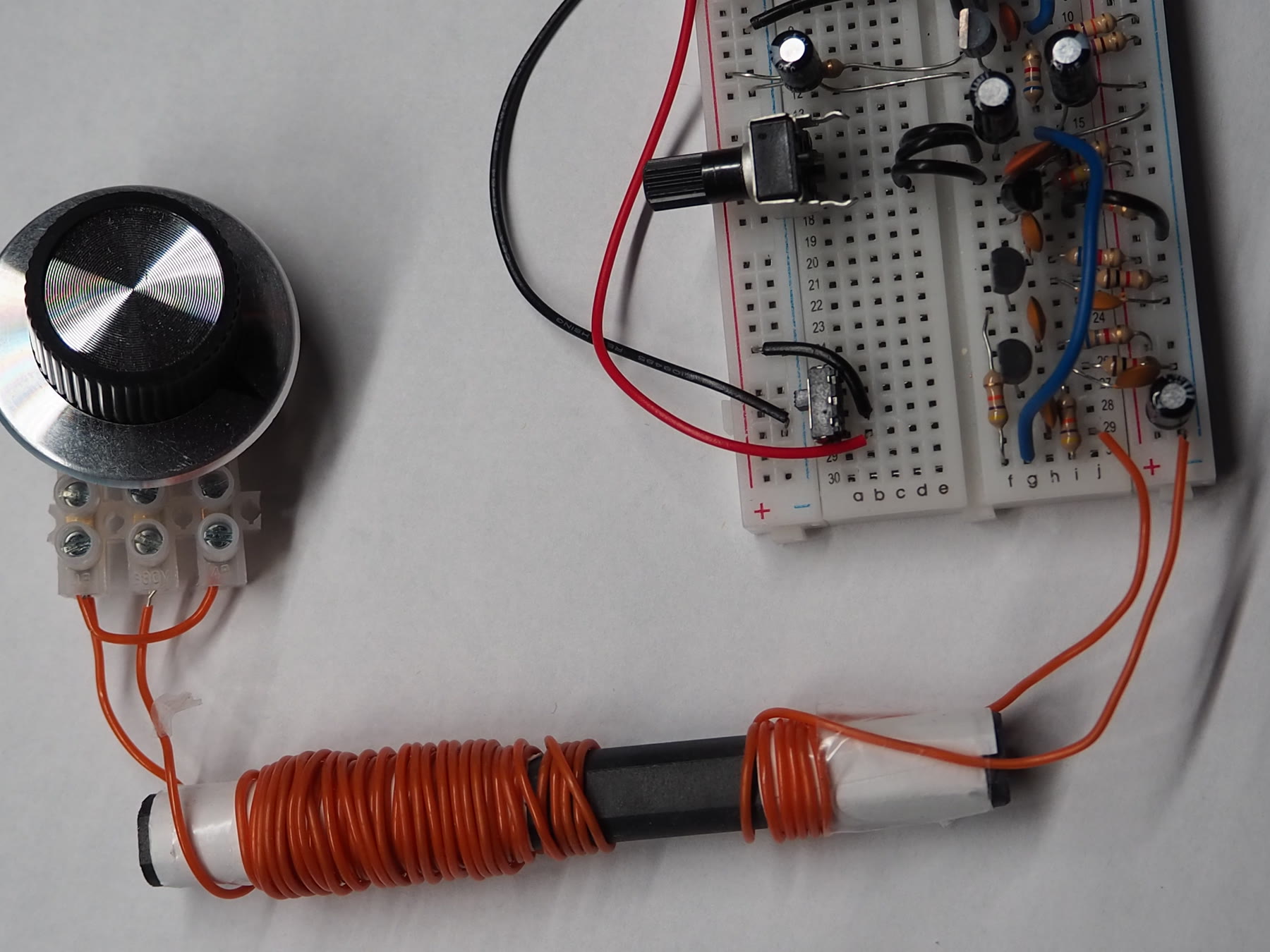
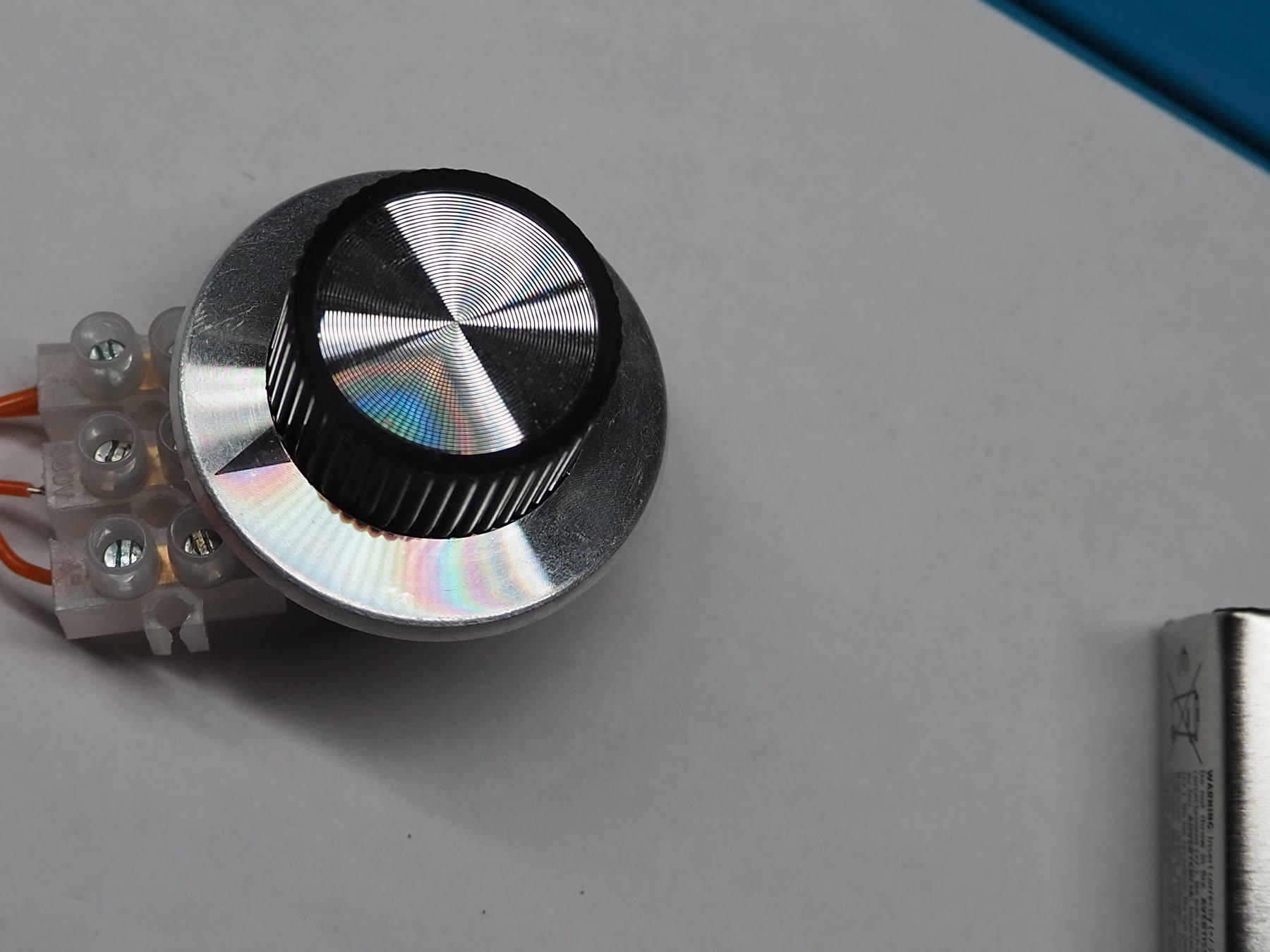
The receiver is divided into layered functional blocks. Each layer has a simple job: select the station, increase RF level, extract the audio envelope, control the audio level, and drive the speaker.
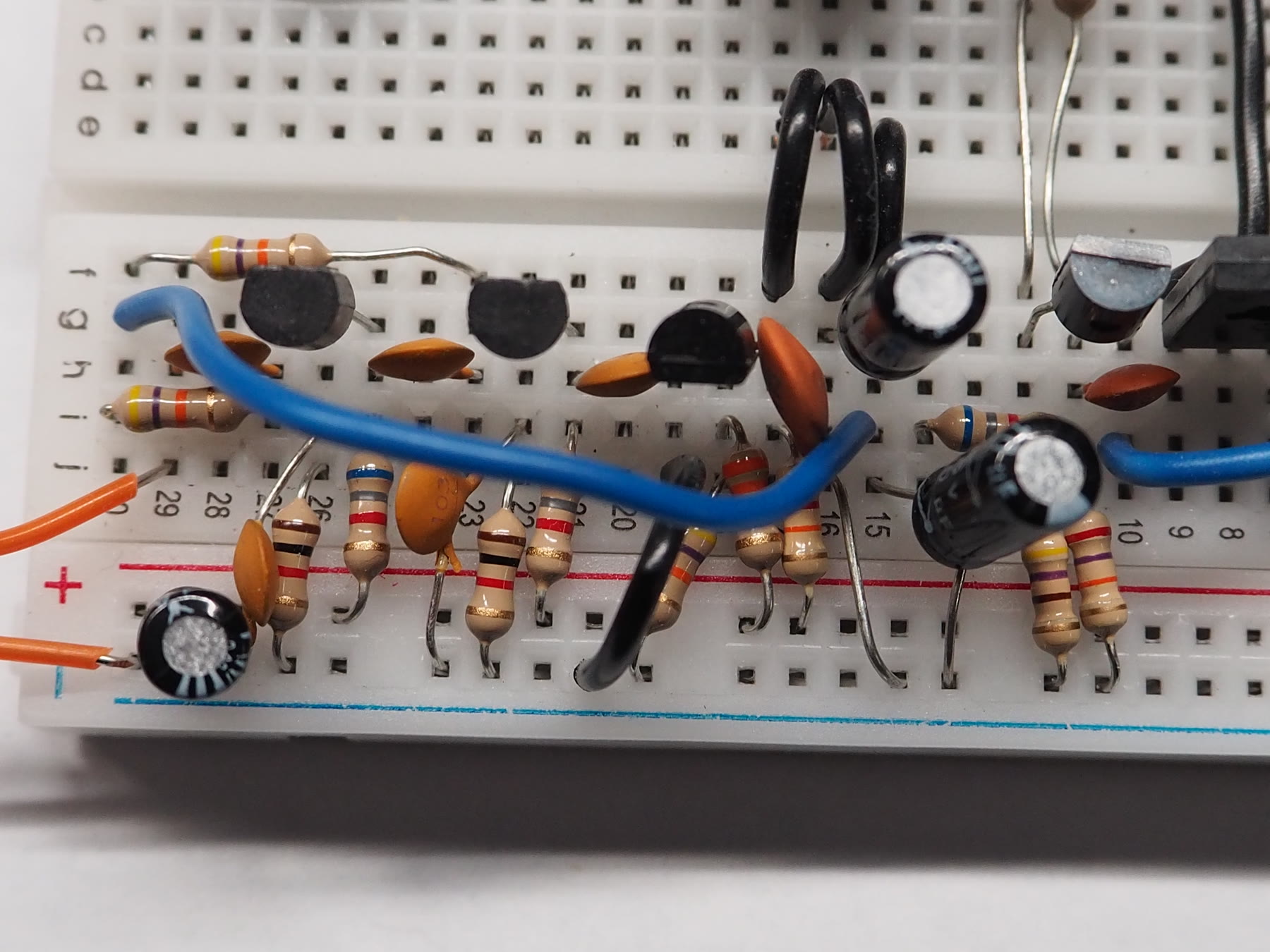
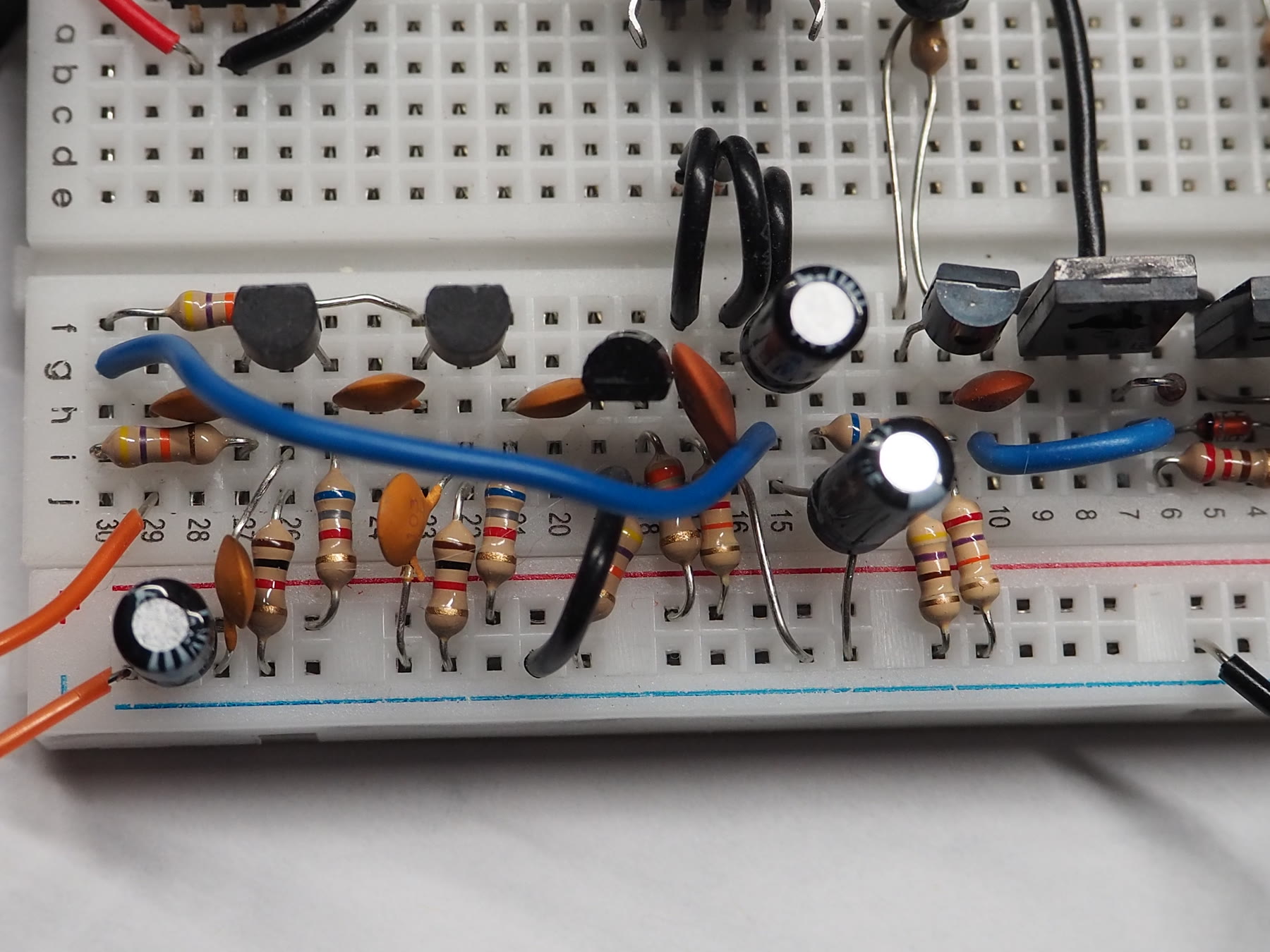
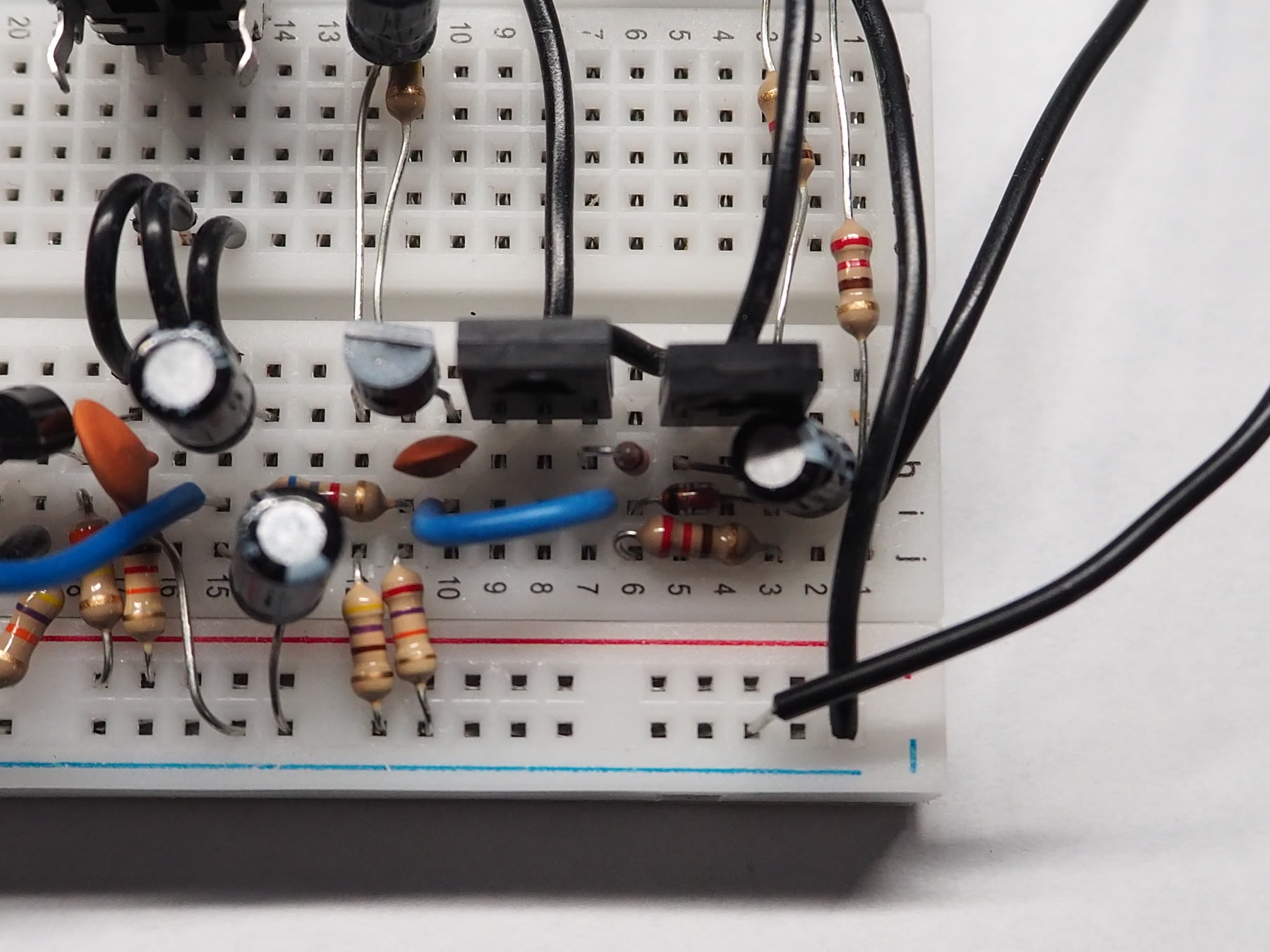
The schematic is treated as a set of layers instead of one large mystery circuit. Open each block below to inspect the role of that part of the receiver.
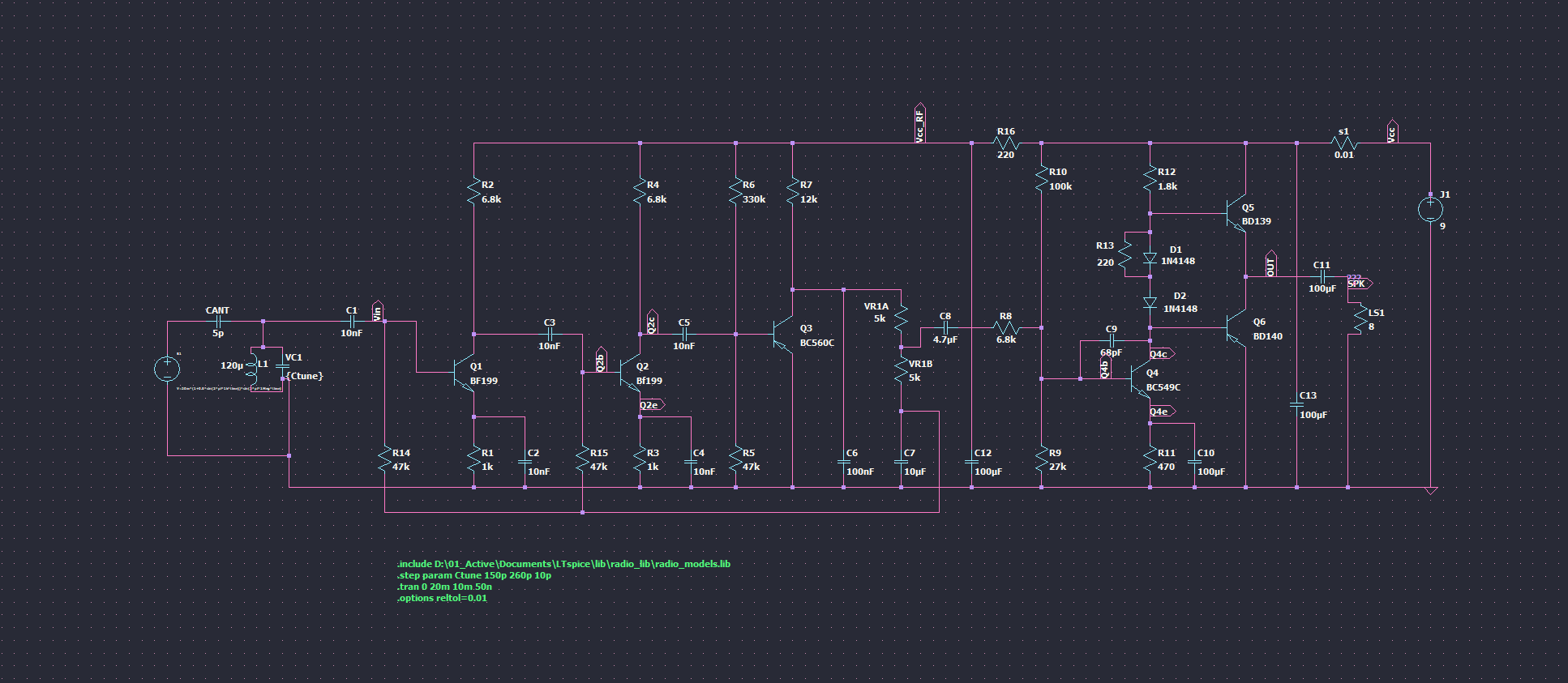
The front end uses L1 = 120 µH and VC1 swept around resonance. This approximates the ferrite rod and variable capacitor combination used in the physical receiver.
Q1 and Q2 provide transistor RF gain after the tuned input. In the simulation, these stages help show how the selected carrier is passed forward before envelope recovery.
Q3 and VR1 form the detector/preamp control layer. This is where the AM envelope becomes the useful low-frequency audio signal and where level adjustment is introduced.
Q4 drives the complementary BD139/BD140 output stage. The output is coupled into an 8 Ω speaker load, represented as a resistor in LTspice for a first-pass simulation.
The physical receiver uses the following discrete parts. Grouped reference designators share the listed quantity and value.
| Qty | Refs | Type | Value / part |
|---|---|---|---|
| 1 | VC1 | Variable capacitor | Approximately 200 pF |
| 1 | L1 | Ferrite rod antenna | 9.5 mm diameter × 100 mm long |
| 2 | R1, R3 | Resistor | 1 kΩ |
| 1 | R11 | Resistor | 470 Ω |
| 1 | R12 | Resistor | 1.8 kΩ |
| 3 | R2, R4, R8 | Resistor | 6.8 kΩ |
| 1 | R7 | Resistor | 12 kΩ |
| 1 | R9 | Resistor | 27 kΩ |
| 3 | R5, R14, R15 | Resistor | 47 kΩ |
| 1 | R10 | Resistor | 100 kΩ |
| 1 | R6 | Resistor | 330 kΩ |
| 2 | R13, R16 | Resistor | 220 Ω |
| 1 | VR1 | PCB volume potentiometer | 10 kΩ |
| 1 | C9 | Ceramic capacitor | 68 pF |
| 5 | C1–C5 | Ceramic capacitor | 10 nF |
| 1 | C6 | Ceramic capacitor | 100 nF |
| 1 | C7 | Electrolytic capacitor | 10 µF |
| 1 | C8 | Non-polar electrolytic | 4.7 µF |
| 4 | C10–C13 | Electrolytic capacitor | 100 µF |
| 2 | D1, D2 | Diode | 1N4148 |
| 2 | Q1, Q2 | NPN RF transistor | BF199 |
| 1 | Q3 | PNP audio transistor | BC560C |
| 1 | Q4 | NPN audio transistor | BC549C |
| 1 | Q5 | NPN output transistor | BD139 |
| 1 | Q6 | PNP output transistor | BD140 |
| 1 | LS1 | Loudspeaker | 65 mm, 8 Ω |
| 1 | J1 | Battery clip | PP3 / 9 V |
| 1 | S1 | PCB slide switch | On/off |
| 1 | — | Plug-in breadboard | Prototype assembly |
| 1 | — | Terminal strip | 3 A, 3-way |
| 2 | — | M2.5 bolts | 4 mm |
| 4 | — | M2.5 washers | — |
| 2 | — | Control knobs | Short shaft |
| 1 | — | Single-core wire | 4 m |
The LTspice source is configured as a controlled AM test signal rather than a real antenna environment. A 1 MHz carrier is amplitude-modulated by a 1 kHz tone, making it easier to verify that the receiver passes RF energy and recovers the audio envelope.
.step param Ctune 150p 260p 10p
.tran 0 20m 10m 50n
.options reltol=0.01Physical receiver result
The completed 9 V breadboard receiver tunes in about three AM stations and produces a relatively loud output from the 65 mm, 8 Ω speaker. Audible static remains alongside the received audio, making noise reduction and front-end selectivity the main areas for continued refinement.
Build demonstration
A short demonstration documents the completed breadboard radio operating as a physical receiver.
Watch on YouTube ↗Representative stable operating points from the completed breadboard provide a concise electrical baseline for the receiver.
| Checkpoint | Measured value | Engineering role |
|---|---|---|
| Battery / VCC | 8.764 V | Operating supply under test. |
| Q1 collector | 7.533 V | First RF-stage collector bias. |
| Q2 collector | 5.27 V | Second RF-stage collector bias. |
| Q3 detector output | 0.003 V DC | Near-ground detector output operating point. |
| Q4 collector | 3.36 V | Audio-driver collector operating point. |
| Q4 emitter | 1.03 V | Audio-driver emitter bias. |
| Output midpoint | 3.86–3.89 V | Quiescent bias for the complementary output stage. |
| Q5 collector / supply side | 8.22 V | Upper output-device supply connection. |
| Q6 base | 3.39 V | Lower output-device bias point. |
| Q6 collector / ground side | 0.003 V | Lower output-device ground reference. |
| Speaker-side DC | 0.03 V | Output coupling keeps DC across the speaker near zero. |
The simulation shows the expected low-frequency audio tone appearing at later nodes and at the speaker load after the RF and detector stages. The variable capacitor sweep gives a way to compare response near resonance and verify that tuning has a measurable effect.
Values below are taken from the 15–19.9 ms measurement window of the supplied transient run.
| Metric | Measured value | Interpretation |
|---|---|---|
| Battery current | 5.527 mA | Approximately 49.74 mW drawn from the 9 V source. |
| RF rail | 8.435 V, 2.566 mA | 0.564 V is dropped across R16 from the audio rail. |
| RF source | 59.71 mVpp | Applied amplitude-modulated test source. |
| LC tank | 0.694 mVpp | Tank/source transfer is approximately 1.16% in this run. |
| Q1 RF gain | 5.44 V/V | Collector peak-to-peak divided by base peak-to-peak. |
| Q2 RF gain | 15.03 V/V | Total Q1-base to Q2-collector gain is approximately 80.3 V/V. |
| Detector output | 2.643 mVpp | VR1 wiper receives 1.094 mVpp, a ratio of about 0.414. |
| Q4 audio gain | 48.69 V/V | 0.316 mVpp at the base produces 15.40 mVpp at the collector. |
| Speaker signal | 3.603 mVpp / 1.226 mVrms | Calculated into the 8 Ω resistor model. |
| Speaker power | 0.188 µW | Overall simulated battery-to-load efficiency is approximately 0.000378%. |
| Speaker DC | −0.222 mV average | The output coupling capacitor removes nearly all DC from the load. |
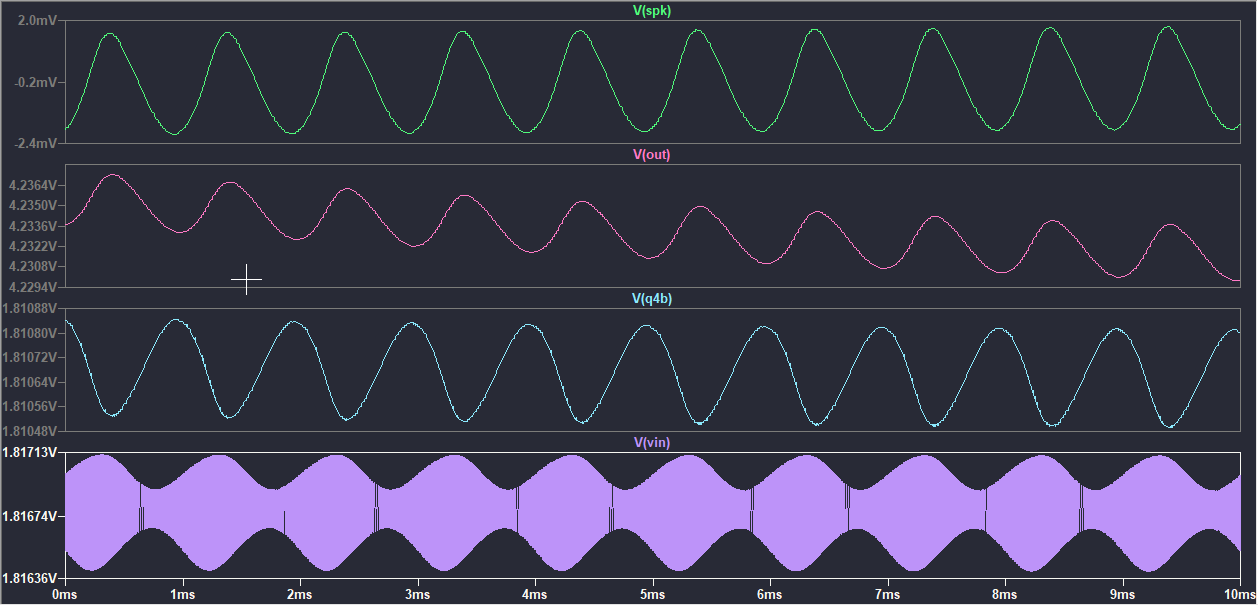
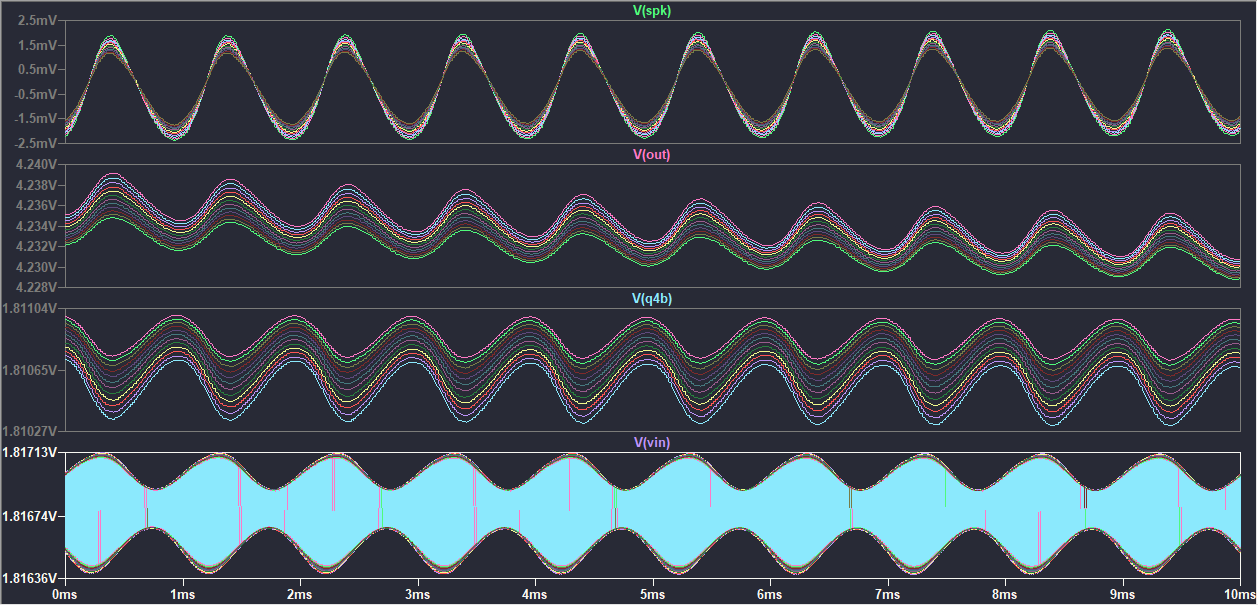
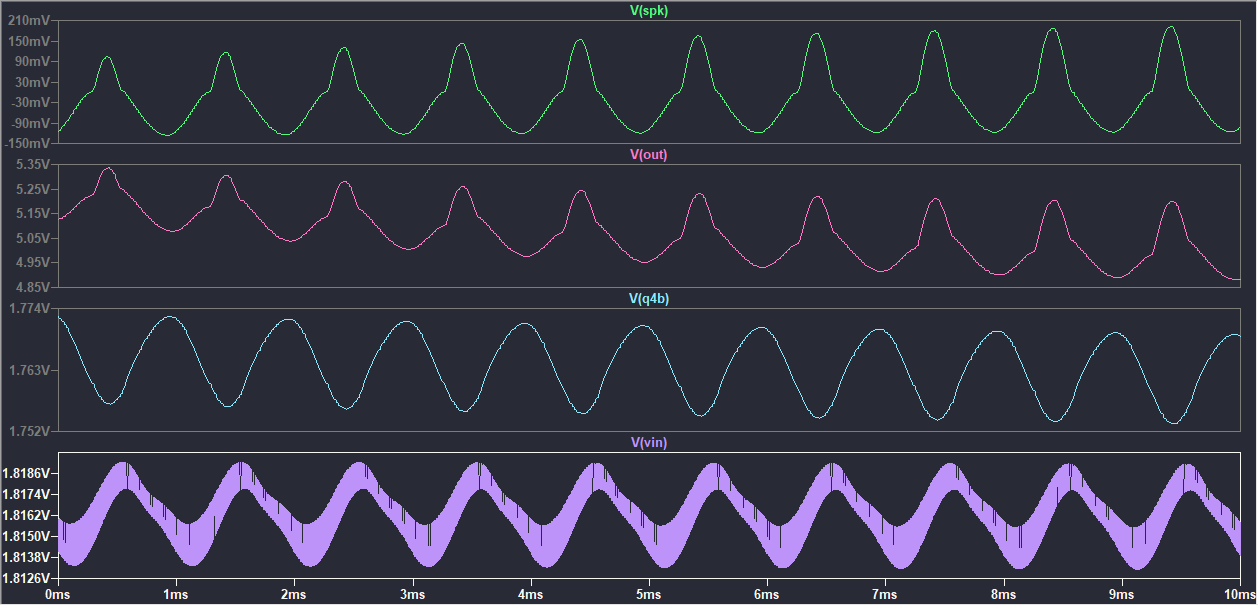
Debugging followed the receiver from input to output, using the schematic as a map and separating RF faults from audio faults. Each stage was checked independently before the complete signal chain was evaluated.
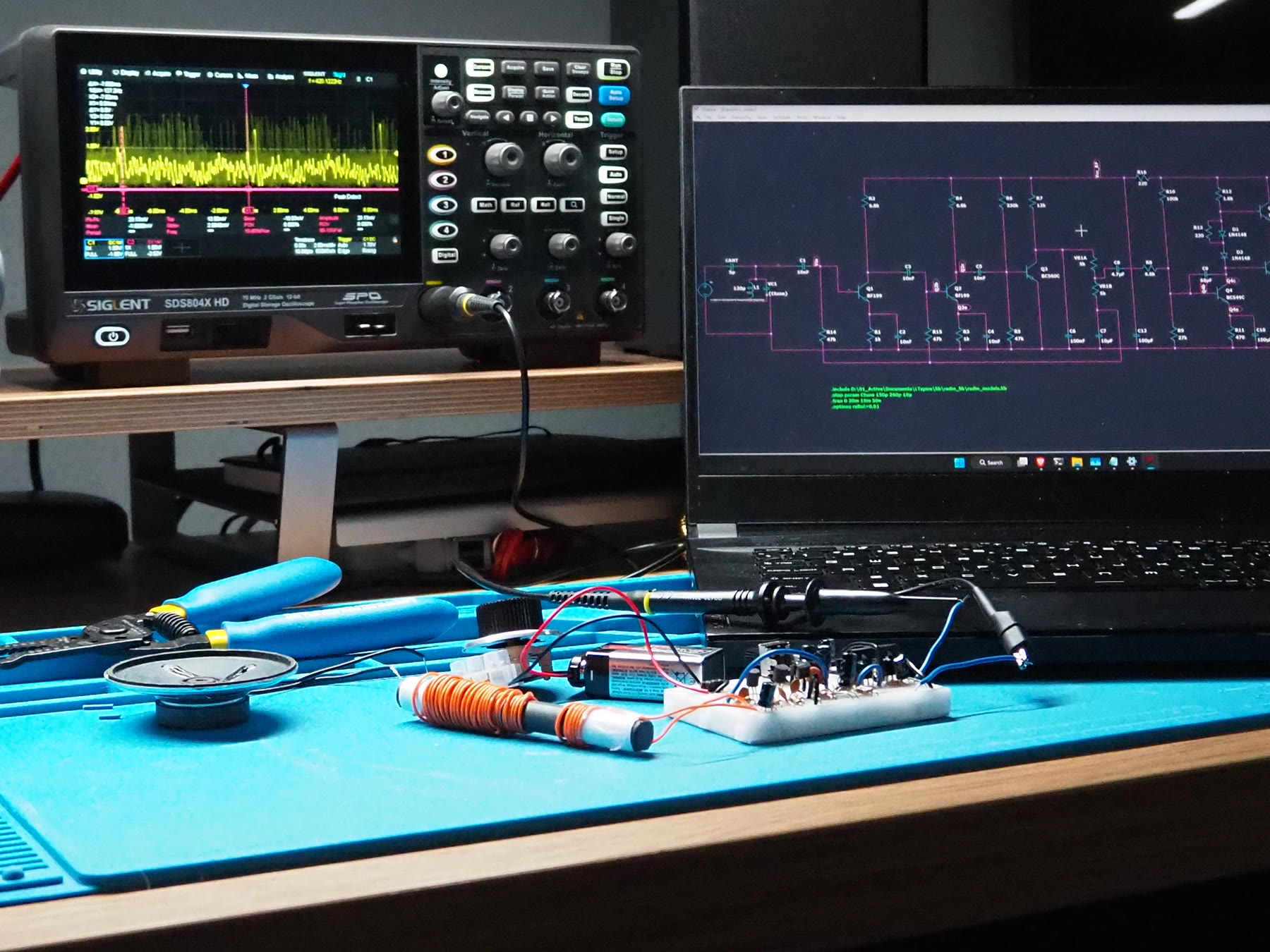
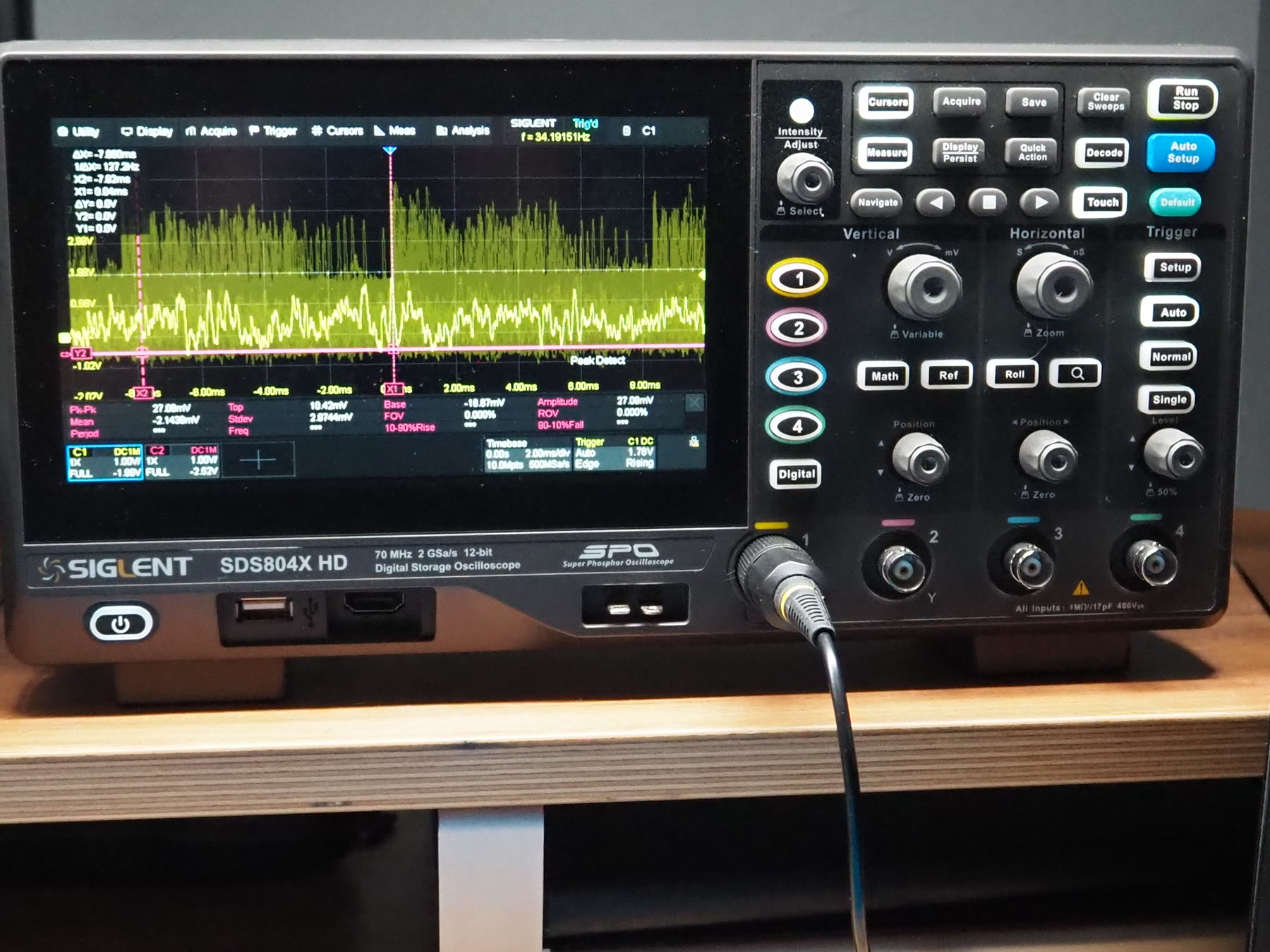
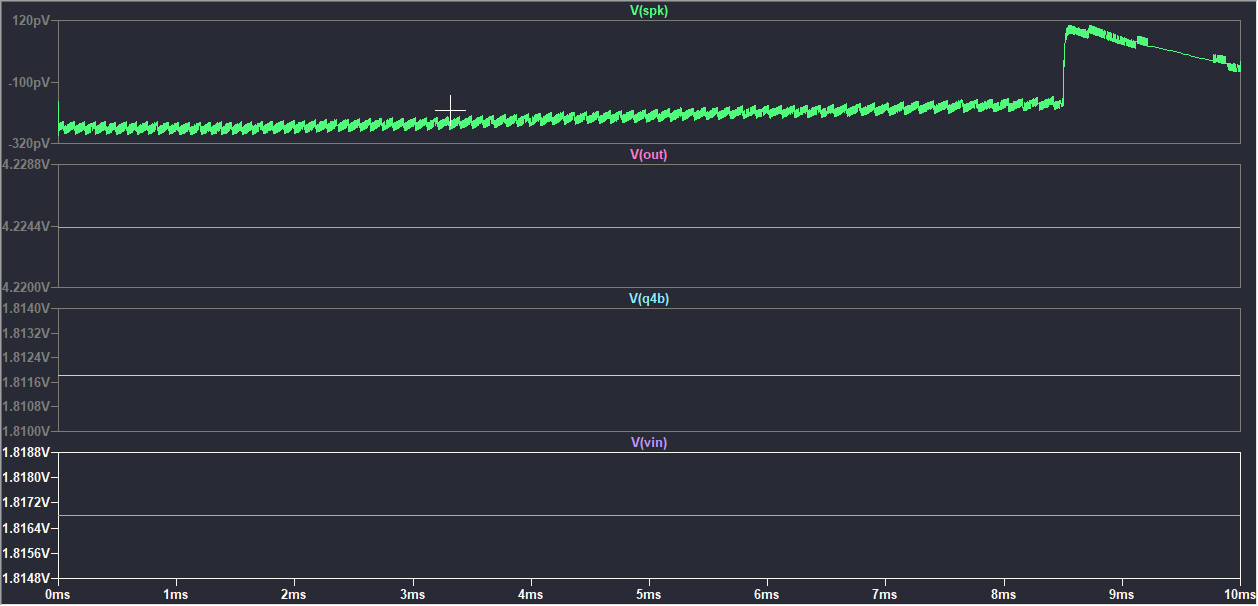
The simulation is intentionally scoped as a circuit-analysis model rather than a full electromagnetic or acoustic model. Its value is in controlled comparison of tuning, stage transfer, and waveform behavior.
The completed project package includes a portable LTspice schematic and the transistor model library used for BF199, BC560C, BC549C, BD139, and BD140 devices.
A 9 V breadboard radio with ferrite tuning, discrete RF and audio stages, volume control, and an 8 Ω speaker.
The finished receiver tunes approximately three broadcast stations with strong audible output and characteristic background static.
Schematic, model library, BOM, simulation setup, waveform results, physical measurements, and debugging method are preserved together.
The project demonstrates a complete analog signal chain using discrete devices: resonance and selectivity at the input, RF voltage gain, envelope recovery, audio amplification, and low-impedance speaker drive.